
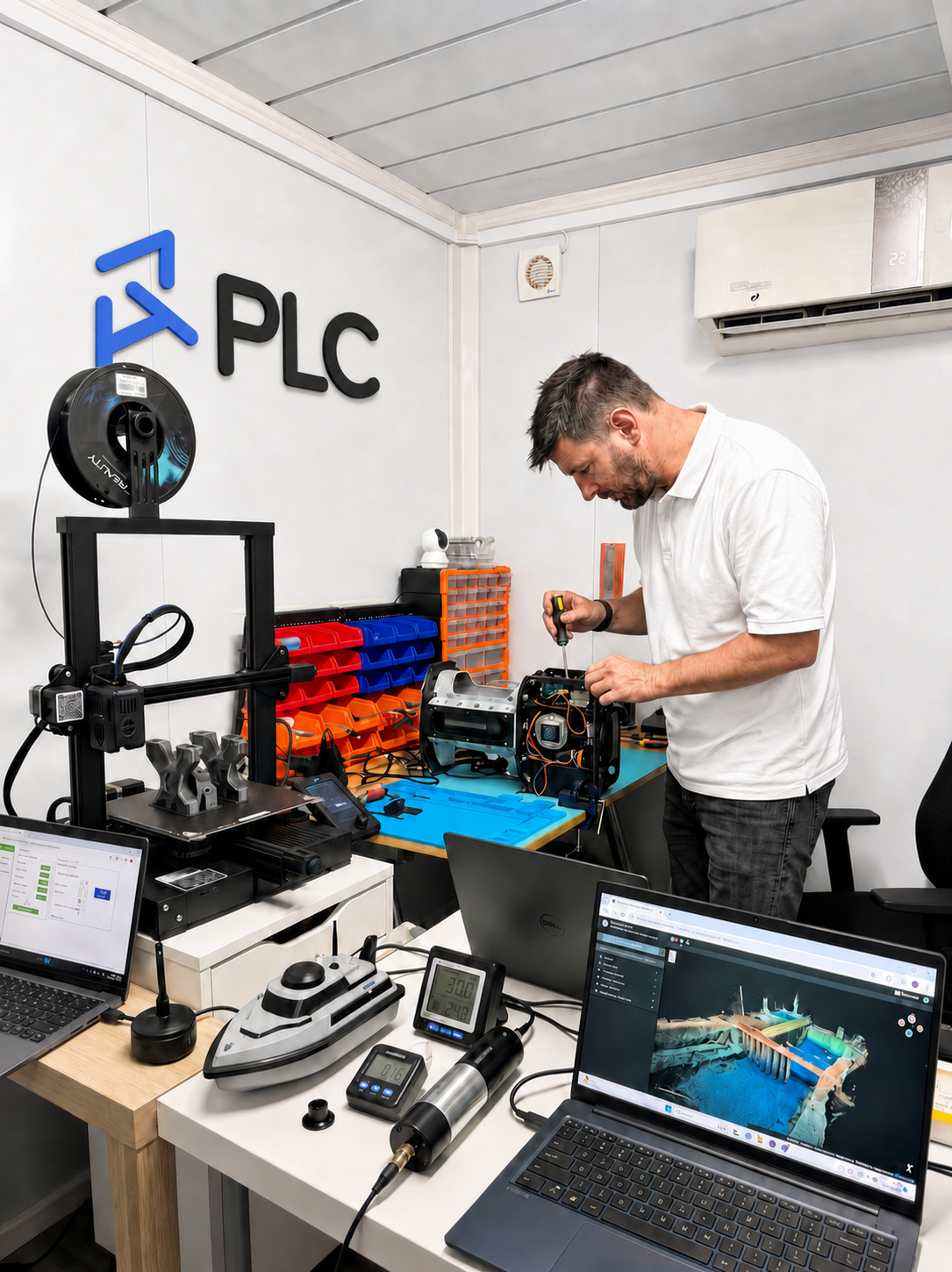
Developed Around Real Project Requirements
Across marine construction projects, surveying requirements can change considerably depending on site conditions, project specifications, access limitations and the nature of the works being performed. Standard commercial systems, while technically advanced, do not always provide the flexibility required to address every operational challenge.
At PLC, our Survey team has taken a practical approach: developing an evolving range of in-house software and custom hardware solutions designed around the specific requirements of our marine, coastal and dredging operations.
The initiative began with a clear operational need. Commercial survey equipment and software can require substantial investment, while complex interfaces and standardized features may not always correspond with the specific tasks our surveyors need to perform in the field.
Technology also evolves quickly. Investing heavily in rigid systems can limit the ability to adapt when new project requirements, surveying methods or technologies emerge. By combining field experience with technical knowledge, our Survey team developed a more agile approach—building straightforward, purpose-driven tools that respond directly to the challenges encountered across PLC’s projects.
An Integrated In-House Survey Ecosystem
Rather than creating one individual piece of equipment, the team has developed an integrated collection of software and hardware solutions.
The in-house software includes programs for coordinate transformations, datum shifts, dredging positioning and structural monitoring. Each interface is designed to display the functions and information required for a particular task, helping surveyors operate the system efficiently without navigating unnecessary features.
The team has also developed and adapted modified remotely operated vehicles (ROVs) and uncrewed surface vessels (USVs), digital tide gauges, conductivity-temperature-depth profilers, AIS sensor arrangements, custom GPS receivers and antennas.
Additional field solutions include indoor GPS repeaters for enclosed working areas, durable custom-made marine cables and sensor adaptations developed to fulfil specific operational requirements. Together, these tools measure and communicate essential information such as position, depth, water levels and structural movement, feeding clear data directly into PLC’s purpose-built software.
Combining Surveying, Electronics and Software Development
Developing the systems required the team to integrate readily available modern components and enable them to perform according to professional surveying standards.
One of the principal technical challenges was establishing reliable communication between components that were not originally designed to operate as one system. The team addressed this by producing custom cables, writing direct communication drivers and continuously refining the software through field testing and surveyor feedback.
This multidisciplinary approach—combining hydrographic and geodetic surveying, electronics, sensor integration, custom wiring and software development—has enabled the team to achieve sub-centimetre accuracy in relevant applications.
Supporting Safer and More Reliable Operations
Safety and operational control were important considerations throughout the development and testing process.
The use of remote USVs and ROVs can reduce the need for surveyors to work close to deep-water edges, confined areas, or heavy moving machinery. Indoor GPS repeaters can also support positioning activities in enclosed spaces where conventional satellite positioning may not be available.
Simplified and standardized software interfaces further support data quality by reducing unnecessary complexity and the potential for manual calculation errors. Surveyors can access the information needed for the task through a clear and consistent operating process.
Delivering Measurable Operational Value
The in-house approach has produced significant operational and commercial benefits. Selected solutions have been developed at approximately 5% of the cost of comparable commercial alternatives. This allows PLC to upgrade, modify, or replace components as technology advances, without the financial impact associated with replacing a complete proprietary system.
The simplified interfaces also reduce familiarisation time. New and junior surveyors can learn to operate the systems within days rather than weeks.
Most importantly, the team can respond directly to emerging project requirements. When a project requires a particular coordinate system, software function or field adaptation, a solution can be programmed and deployed within hours rather than waiting weeks for external vendor development or support.
Building Capability Within the Team
The value of the initiative extends beyond the equipment and software itself. PLC’s surveyors are trained to understand how the systems function, enabling them to troubleshoot issues directly in the field and respond more confidently when operational challenges arise.
This reduces dependency on external technical support and helps the team deliver accurate survey information to project teams without unnecessary delays. The approach strengthens internal capability by combining formal surveying knowledge with practical problem-solving and continuous learning.
Continuous Improvement Driven by the Field
PLC’s in-house survey solutions are currently used across our marine and coastal projects. They continue to evolve as the team encounters new project conditions, technical requirements, and opportunities for improvement.
For PLC, innovation is not limited to adopting the latest technology. It also means understanding the challenge, questioning the standard approach and developing the right solution for the work at hand.